Sir Henry Cecil
Printed From: Thoroughbred Village
Category: Horse Racing - Public Forums
Forum Name: Tributes Forum
Forum Description: Personal tributes to past and present day champions. Lest we forget our turf heroes.
URL: https://forum.thoroughbredvillage.com.au/forum_posts.asp?TID=69565
Printed Date: 27 Mar 2026 at 12:35pm
Software Version: Web Wiz Forums 12.05 - http://www.webwizforums.com
Topic: Sir Henry Cecil
Posted By: djebel
Subject: Sir Henry Cecil
Date Posted: 10 Jun 2023 at 2:45pm
------------- reductio ad absurdum |
Replies:
Posted By: djebel
Date Posted: 10 Jun 2023 at 2:49pm
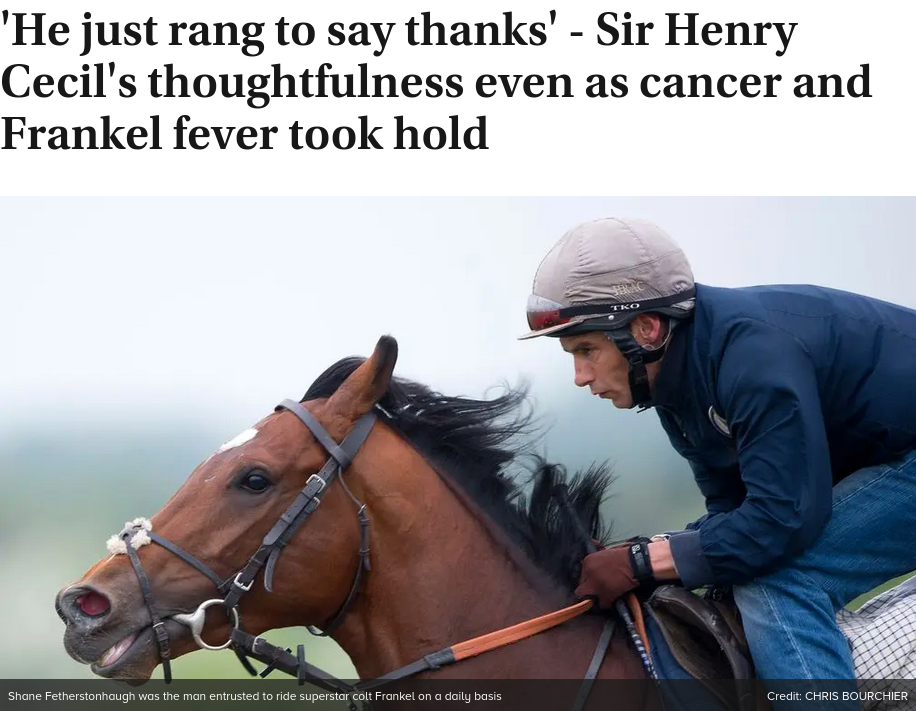 The legendary https://www.racingpost.com/profile/horse/763453/frankel/?_sgm_campaign=fcs_ac017b2e36000&_sgm_source=H763453%7Cproduct&_sgm_action=search&_sgm_term=frankel" rel="nofollow - - Frankel's work-rider has recalled being touched by the faith shown in him by Sir
Henry Cecil even at the height of the illness that led to his death –
and by a phone call that thanked him for one of the unbeaten superstar's
final victories. Shane Fetherstonhaugh, along with the likes of Steve Cauthen, Luca Cumani and William Jarvis, was speaking to the Racing Post as part of a major feature in Sunday's newspaper that explores the ten-time champion trainer's career and legacy ten years to the day from his death due to stomach cancer at the age of 70. Fetherstonhaugh was part of Cecil's team at the end of his career and the man entrusted to ride the eager Frankel on a daily basis at a time when Cecil's genius really came to the fore. "Frankel was very forward as a two-year-old and the thing that sticks in my mind is how Henry used to manage his work," recalled Fetherstonhaugh. "Normally when you're galloping horses, your good horse will sit in behind and then you'd pull out and let him join up or go by, but what Henry always emphasised was that if he was trying to do too much in behind the lead horse, leave him there, so he wouldn't get into the habit of just pulling out and going. "I've worked with horses a long time and that's never happened before to me. You didn't want to disappoint him, but with Henry in charge he learned over time and by his four-year-old season you could do anything with him at home and in a race." Cecil also demonstrated his knack with people even as his own health suffered. "Henry was very ill in that last season," said Fetherstonhaugh, "and I took great pride in the fact that when he was struggling, he trusted me to do what he wanted. That belief in me is something I hold dearly. "He rang me once after a win and thanked me for my part in it, and I said: 'Henry, I'm just doing what you want me to do.' That was the truth of it with all of us – we just tried to carry out his plan." ------------- reductio ad absurdum |
Posted By: acacia alba
Date Posted: 10 Jun 2023 at 9:04pm
|
I had the pleasure of meeting Sir Henry a few times, as a friend worked for him for years. Visited Warren Place while Frankel was in residence. And got a tour of his beloved rose garden. He was an amazing, and quite funny man. Very gracious . And he loved the ladies.  ------------- animals before people. |
Posted By: Carioca
Date Posted: 10 Jun 2023 at 9:31pm
| Nothing wrong with that , as long as you don't marry one . 😂👍 |
Posted By: acacia alba
Date Posted: 11 Jun 2023 at 12:05am
|
Well, he married 3. Have it on good authority the first was a lady. Not so sure about the next 2 tho. He did tell a funny story, the gist of which was that he had been ask to ride in the Queens carriage procession at Royal Ascot three times, which he didnt much enjoy, but made all 3 of his wives happy. ------------- animals before people. |
Posted By: djebel
Date Posted: 12 Jun 2023 at 9:33pm
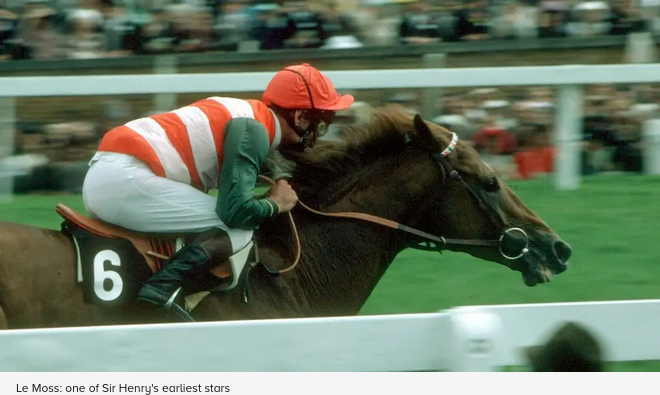
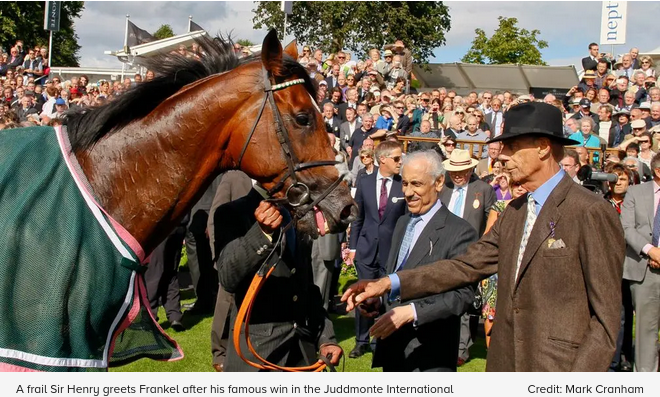
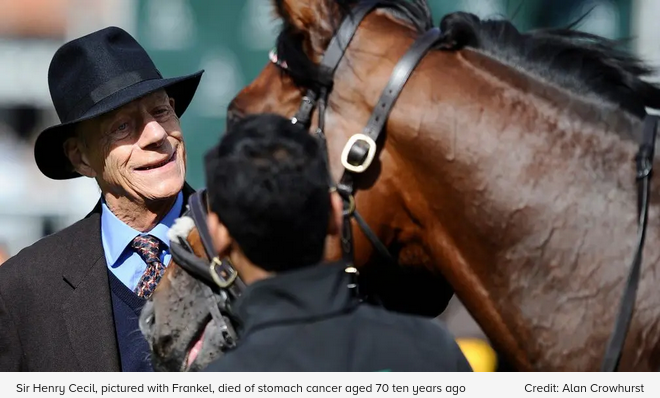
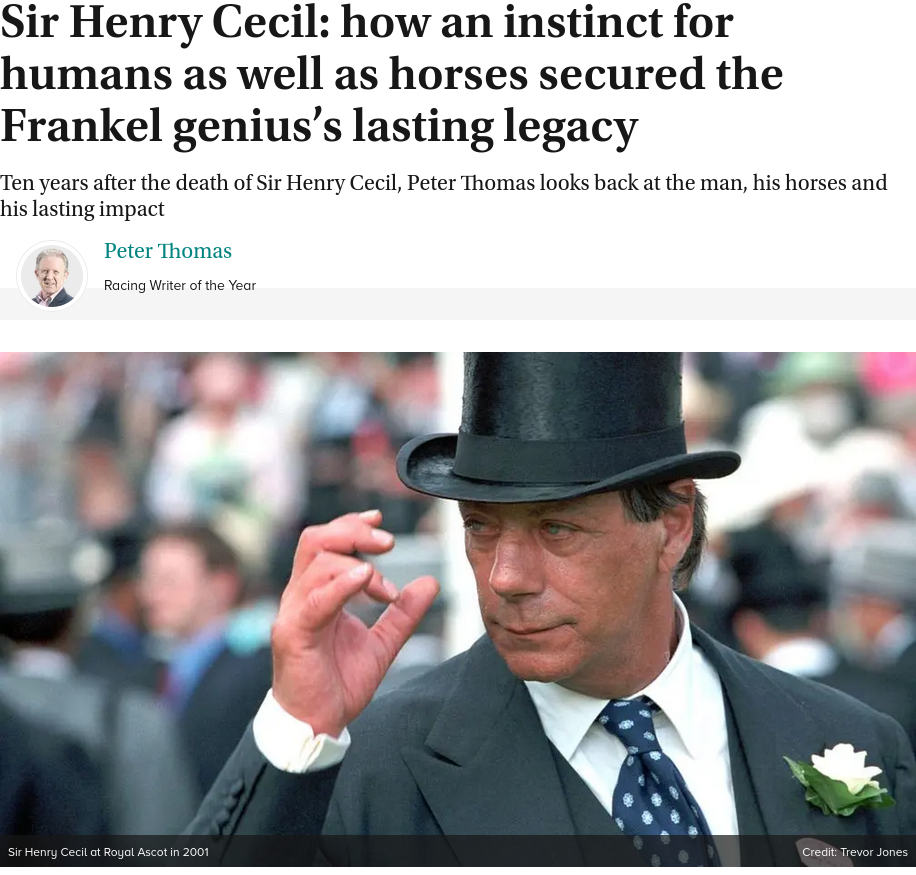 When Sir Henry Cecil died ten years ago on Sunday he was celebrated as one of the greatest trainers we've ever seen. Having struggled through his years of turmoil and isolation, he'd regrouped, buoyed by the help of good friends, and ended his life amid uplands brightly lit by the best horse he, perhaps anybody, had ever trained. Frankel was Cecil's parting shot, the horse who put into a nutshell the instinctive genius of the ten-time champion trainer. As the mighty beast begins to compile a stallion career that seems likely to involve the creation of lasting dynasties, now is a good time to reflect on Cecil's contribution to the ongoing story. The man who coaxed an unbeaten 14-race career out of the son of Galileo had been acclaimed for his rare gift many times, but this was his magnum opus, and those closest to him are happy to recognise that in performing it he left behind him a legacy that will shape the thoroughbred breed for generations. There was a humbling spell in the doldrums for Cecil, during which both quality and quantity of horse deserted him cruelly, but the list of top-class horses in his glory days was a long one, from Eclipse hero Wolver Hollow in his first year with a licence in 1969, to Bolkonski and Wollow in the mid-1970s, to Kris and One In A Million later that decade, and to the unforgettable likes of Classic winners Oh So Sharp, Slip Anchor and Reference Point in the 1980s. For many of his staff in those early years, however, there is one horse and one individual body of work that stands out. Cecil himself called it his "greatest achievement" and perhaps only the Frankel years matched it for sheer genius. Le Moss was a great staying talent but an unwilling worker and just the wrong horse to suffer a hock injury in the spring of what was supposed to be the year of his second Gold Cup triumph. His lad, Willie Walker, later described the leg in question as being "so full of fluid it looked like a tree stump", and when the trainer had nursed him back to soundness he faced the quandary that this was possibly the laziest horse in the yard yet the one most in need of hard graft. Le Moss would regularly plant himself on the gallops while assistant trainer Willie Jardine waved a hunting crop at him to zero effect. It was just what was not required, with the up-and-coming Ardross waiting to take him on at Ascot. Another assistant, William Jarvis, recalls the situation vividly: "You couldn't do fast work with him, but luckily Clive Brittain had a swimming pool he let us borrow, and as he became sounder I used to go out on a hack, with a big, heavy lad on Le Moss, and we'd trot for an hour and a quarter during evening stables. "Even when he became sound enough to resume cantering, we still took him out at evening stables and he got himself fit without even knowing it and without hurting himself to get there. "We never put the gun to his head, because you just couldn't, but Henry conditioned him beautifully and got him to Ascot ready to beat Ardross."
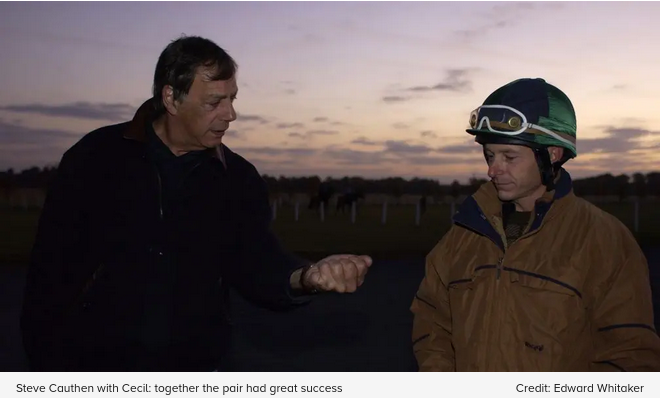
Then there was Gunner B, a Group 3-winning colt for Geoff Toft in Yorkshire in his early years, who moved south to the Cecil yard as a cantankerous five-year-old in 1978 and was transformed into a beast capable of winning the Prince of Wales's Stakes and the Eclipse. Neither Le Moss (sire of top chaser Scotton Banks) nor Gunner B (sire of disqualified Ascot Gold Cup winner Royal Gait and Grand National hero Red Marauder) produced great champions on the Flat, unlike the mighty Kris, the dominant miler of 1979, whose exploits as a stallion gave rise to Cecil's wonderful Fillies' Triple Crown winner Oh So Sharp, for whose era the trainer was joined by his best pal from Kentucky, Steve Cauthen. Cauthen had been to the top of the tree in American racing but even he was impressed by the intuitive gift that his new boss displayed for unravelling equine puzzles. "Henry had an innate talent for being able to look at a horse, see the talent and judge how fast or slow he should be progressing with them," he recalls. "Some horses he would just kinda put on the backburner of his mind, because he knew they needed time, but sometimes he knew right away, like with [the 1987 Prix de Diane heroine] Indian Skimmer. She broke her maiden at Wolverhampton and he threw her straight into a stakes race because he could tell she was more than ready for it. "He was always thinking. He'd be talking to you but he'd still be thinking about his horses, and sometimes you'd be sitting there and you'd realise he wasn't paying attention to what you were saying because he had something more important on his mind." If Cecil was known for one thing, it was his seemingly effortless bond with the horses he trained. It may have sprung from his days as assistant to his stepfather Sir Cecil Boyd-Rochfort in Newmarket, or it may have been a natural talent, but it never ceased to amaze those around him. "I remember giving the horses a pick of grass in the paddock at evening stables in the summer," says Jarvis, "and a filly got loose and was careering around like crazy. "We were running around like clowns, flapping our hands trying to catch this wretched thing, and Henry saw what was going on, walked into the paddock and said, 'Whoa, girl', and she pricked her ears and trotted straight up to him. "It was a special gift he had, although I'd say it must have been one of his better fillies, so she knew him and he knew her." Luca Cumani, another assistant in the days when both men were young and the trainer was "making waves", reinforces the notion that Cecil, while he understood most horses, was far keener on the good ones. "Sometimes it was very hard to understand certain things he did but most of the time he was right," he explains "It was an instinct for doing the right thing with the horses, but he wasn't particularly interested in winning handicaps, so once he thought a horse wouldn't come up to his expectations, he'd probably lose a bit of interest in it and not be quite so determined with it anymore." Here was a trainer who, as an under-achieving schoolboy, was keen to make an indelible mark. He may have looked whimsical and foppish, but beneath it all there was a fiercely competitive streak, according to those who knew him. "He was very determined, almost to the point of ruthlessness, and incredibly ambitious, not at all as laid-back as he was portrayed to be," stresses Cumani. "As long as you did your job properly, he was fine and easy to get on with, but he wasn't quite the way people thought he was." Cauthen remembers a multi-faceted man. "He was a character, the way he'd carry himself, the way he liked to make people laugh about his quirkiness, but inside he was always on the ball," he says. "He was a little shy, but he was like an actor; when he was 'on stage' he would be flamboyant, with his Gucci shoes and all the fancy stuff. And when you're that good, you can get away with anything." Jarvis, meanwhile, recalls experiencing a little rough with the smooth. "It wasn't a bed of roses every day, I can assure you of that," he says. "He could be grumpy and quiet if the morning wasn't going well. If there was a cloud hanging over his head, you knew to give him a bit of distance, but he was a wonderful person and he, [Cecil's first wife] Julie and [head man] Paddy Rudkin were a wonderful team, backed up by some very able and competent horsemen."
There we seem to have come to the nub of the Cecil mastery. Yes, he was a genius with a ruthless streak and a nice line in Hermes ties, but his abiding strength lay in the instinct he had for human beings, which allowed him to assemble one of the finest armies of stable staff in town. Among them are some who went on to fine training careers themselves, utilising what they had learned and passing on a new way of doing things to the next generation. Along with Cumani, Jarvis, Rudkin and Jardine, there was the lynchpin of the outfit, Julie, a popular figure who also happened to be the daughter of another great trainer, Sir Noel Murless – and the people who worked for him all felt a part of the team. "He made me feel like he had full confidence in me right from the beginning," says Cauthen. "Julie was there at the time and she was fantastic, a big part of the good days, for sure. "My problem was [Cecil's second wife] Natalie and I was afraid of what was going to happen when she was around, so when the opportunity came I moved on [to ride for Sheikh Mohammed], but even then we didn't fall out, although it wasn't the same as those blissful six years with Paul Eddery and Willie Ryan riding with me." Jarvis also recalls the golden age with pride and affection. "We would have a string of 55 horses go out and I'd say at least 46 of the people on them could ride in a good gallop," he says. "He had boys and girls that could ride fragile fillies and he had good, strong, capable riders that could ride the most boisterous colts, and he used to have the right people riding the lead horse every time. "Henry was a marvellous boss. There was no raising of voices. He'd raise his eyebrows and shrug his shoulders, but very rarely did he shout at anyone. It was a calm environment and that transmitted to the horses, I'm sure." Not that every old-school trainer was a strutting martinet, but Cecil soon established himself as a new broom rather than a rod of iron. Rudkin, for example, had long experience of military-style discipline in the workplace and was a little taken aback when the new man breezed in and swept much of the pernickety detail from his daily routine. "I worked for Teddy Lambton and Captain Boyd-Rochfort and they did things the old-fashioned way at stable time. As soon as Henry took over, he changed all that and it was a big shock for me. "He didn't believe in wasting time – just wipe them over and get them into the paddock. It was all about knowing the horses, and he watched them all the time, carefully. "We had a routine of course. I'd go and check everything every night, but he'd never have an evening stable unless an owner was coming; otherwise he'd just wander round at night and look at what he wanted to look at and carry on, and he never really interfered with the running of the yard. He was always very relaxed." Cecil knew all his staff, so Rudkin says, and knew which of them to put on any given horse on any given morning: "The lads would have done their horses that morning but two or three of them wouldn't be allowed to ride them because they didn't suit them. But nobody really complained because he did it for the benefit of the horse. "I was there for 24 years and I don't think anybody left to go to another trainer, which says a lot." When the 'board' was done, Cecil liked his horses to work hard, as Cauthen recalls: "He did strong canters all the time. They were doing it all within themselves, but they got toughened up, and I was never afraid when I was on one of Henry's two-year-olds. "He fed them right and he knew when to back off and give them a little breather, do something different that was mentally appealing to them, and I didn't care if we were up against Stoute, Guy Harwood, whoever – when we got to the final furlong, unless they were that good they could blow right by me, I was going to beat them ten out of ten times, and even if they had to dig in a little bit, they'd come out of it and improve 10lb." Cecil's attention to detail concerned not the mundane drill of stable management but the wellbeing of the horse, which he could detect by empathy and observation, to devastating effect. "He knew when a horse was on song, and when they were on song he wasn't afraid of anybody," concludes Cauthen. "He knew he had his horse right and he'd take on the world." Which brings us full circle, back to Frankel, the horse with whom Cecil took on the world and whipped it. His abiding links with long-term allies such as the Niarchos family and Khalid Abdullah had brought him back from the wilderness, with the likes of 2007 Oaks winner Light Shift and the prolific Midday, but his last turned out to be his best. That was thanks in large part to the man himself as he uncovered the full talent of the horse who became the greatest any of us has ever seen. Those who had been with him at the beginning watched on in awe. Jarvis asserts: "A lot of trainers would have ruined Frankel – it was another instinctive connection."
Shane Fetherstonhaugh was the man entrusted with riding the eager horse on a daily basis, and his testimony suggests that admiration for the trainer's skills diminished not one jot with time. "Henry was never swayed by anyone else – he just did what he thought was right by the horse," says the talented work-rider. "Frankel was very forward as a two-year-old and the thing that sticks in my mind is how Henry used to manage his work. Normally when you're galloping horses, your good horse will sit in behind and then you'd pull out and let him join up or go by, but what Henry always emphasised was that if he was trying to do too much in behind the lead horse, leave him there, so he wouldn't get into the habit of just pulling out and going. "I've worked with horses a long time and that's never happened to me before. You didn't want to disappoint Frankel, but with Henry in charge he learned over time and by his four-year-old season you could do anything with him at home and in a race." Cecil's knack with people hadn't left him, either. He might have been forgiven for becoming wrapped up in the stressful exercise of managing his own, and the horse's, legacy, but not a bit of it. "Henry was very ill in that last season," recalls Fetherstonhaugh, "and I took great pride in the fact that when he was struggling, he trusted me to do what he wanted. That belief in me is something I hold dearly. "He rang me once after a win and thanked me for my part in it, and I said: 'Henry, I'm just doing what you want me to do.' That was the truth of it with all of us – we just tried to carry out his plan." It was a plan that was all Cecil's own and lasted him for a racing lifetime. It was greatness combined with humanity, and that's how he'll be remembered. ------------- reductio ad absurdum |