


|

Magical Lagoon |
Post Reply 
|
| Author | |
Ticino 
Champion 
Joined: 20 Oct 2008 Location: Germany Status: Offline Points: 4980 |
 Post Options Post Options
 Thanks(1) Thanks(1)
 Quote Reply Quote Reply
 Topic: Magical Lagoon Topic: Magical LagoonPosted: 18 Jul 2022 at 12:07am |
|
Hello,
nice to see a horse winning the Irish Oaks with a German Background. Magical Lagoon traces back to the German taprootmare "Nella da Gubbio" (by Grand Parade) a granddaughter of 'Catnip' (Nearco, Niccolo dell'Arca) After this branch was pretty "Quiet" for several years, it made a great "running return", with Nutan (German Derby winner), Next Gina, Novellist (her HB), Next Desert (German Derby winner), Next Gina, Near Honor, Night Flower, Nordtänzerin, North Queen, Nadour Al Bahr, Nancho etc. Not to forget the very good, but wayward "Pakistan Star" (formerly Ninas Shadow). Btw, his close relative (filly) Ninas's Lob (by Lope de Vega) broke her maiden at Mülheim/Ruhr (3. Race, 3 year old fillies, Category D, 2000 meter) regards, Ticino
|
|
 |
|
|
Ticino
Champion
Joined: 20 Oct 2008 Location: Germany Status: Offline Points: 4980 |
Post Options
Thanks(1)
Quote Reply
Posted: 18 Jul 2022 at 12:19am |
|
Hello,
an interesting update to my info. Abhayaa (IRE)(Australia-Navajo Moon by Monsun) just won the "Diana Trial" (Listed Race, 6. Race, Fillies. 3 year olds, 2000 meter), at Mülheim/Ruhr. Navajo Moon is a FS of Novellist, what I wasn'r aware yet. regards, Ticino |
|
|
|
|
furious
Champion
Joined: 19 Feb 2007 Status: Offline Points: 30976 |
Post Options
Thanks(0)
Quote Reply
Posted: 18 Jul 2022 at 11:11am |
|
nice to see the line coming back to the fore. There was no better going around in his day than Nearco who was a breed making stallion.
|
|
|
|
|
djebel
Premium 

Joined: 07 Mar 2007 Status: Offline Points: 56200 |
Post Options
Thanks(0)
Quote Reply
Posted: 21 Jul 2022 at 1:52pm |
|
German Breeding. German Excellence. 'We're good at breeding stayers, we're not good at breeding a July Cup winner'Aisling Crowe on how and why Germany's breeding industry is small but successful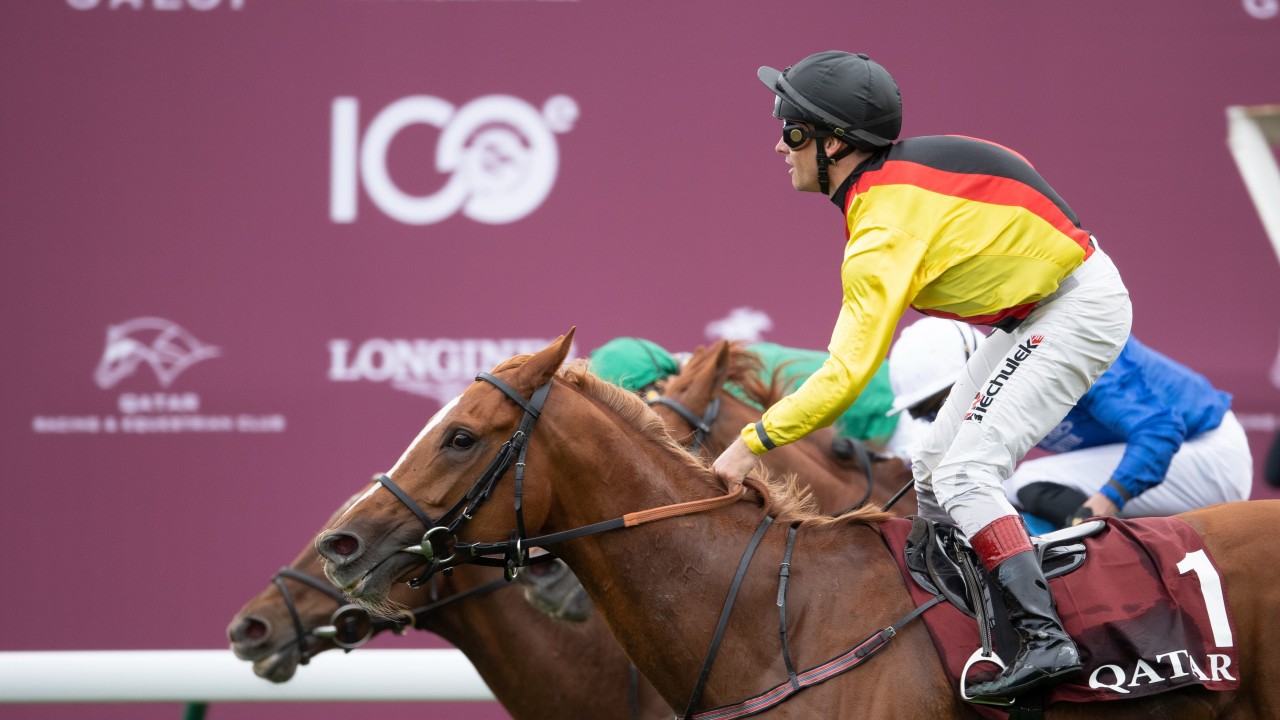 A decade on from Danedream's breakthrough success in the King George VI and Queen Elizabeth Stakes, another Arc winner bred and trained in Germany travels to Ascot with designs on victory. Torquator Tasso's presence in Saturday's Group 1 contest, the midsummer jewel in British racing's crown, and his status as the reigning Prix de l'Arc de Triomphe winner are all the more remarkable when his origins are taken into account. Germany produces approximately 850 foals each year and four-fifths of them are by breeders with just one or two mares. Last year's Arc winner represents the beating heart of German bloodstock. His breeder Paul Vandeberg has just one mare, Torquator Tasso's dam Tijuana, and his late sire, the 2007 German Derby winner Adlerflug, was from a branch of one of Germany's most influential families. "I think it is something special," says Daniel Kruger of Deutscher Galopp, the major umbrella body under which racing is supervised and which promotes thoroughbred breeding. "Mr Vandeberg doesn't have a big stud farm or big breeding empire with millions of euros behind it from other businesses. He is a prime example of German breeders. He is very patient, has one mare and has received fantastic offers to sell her but he didn't. "He is a retired businessman and enjoys working with his horses, he sells the colts at auction and keeps the fillies to race himself. People like him are the backbone of the German racing and breeding industry." In addition to that, Torquator Tasso is inbred to full-sisters, one of whom is arguably the most influential German-bred horse of the past 40 years, Allegretta, who, particularly through her daughter Urban Sea, the dam of Galileo and an Arc winner herself, has become one of the most potent forces in middle-distance racing pedigrees globally. Germany's influence on middle-distance races the world over is even more impressive when considering the size of the breeding industry there. Although Magical Lagoon, victorious in last weekend's Irish Oaks, was bred in Ireland, her family is German through and through. She is a Galileo half-sister to Novellist, whose four Group 1 triumphs included the 2013 King George, out of the Lagunas mare Night Lagoon who was bred, like Novellist, by Dr Christoph Berglar, and was Germany's champion two-year-old filly in 2003. Night Lagoon was acquired by Coolmore after Novellist's emergence as an excellent middle-distance performer.
The recent history of the Arc – Sea The Stars's memorable triumph in 2009, Danedream's 2011 victory, Galileo's unprecedented 1-2-3 in 2016, Waldgeist dashing Enable's bid for immortality in 2019, In Swoop's narrow second in 2020 and Torquator Tasso's stunning success last year – has German fingerprints all over it. The King George in the last ten years has also been shaped by German bloodlines primarily through Galileo, who followed up his Derby success in 2001 with victory over Fantastic Light at Ascot. A decade later his son Nathaniel won the race and he is the sire of Enable, the only horse to claim a hat-trick of victories in the contest. Galileo's son Highland Reel won in 2016 and his grandson Adayar, by Frankel, emulated Galileo last year when adding the race to his Derby crown. Galileo's half-brother Sea The Stars sired 2014 heroine Taghrooda from his first crop and her victory followed successive wins in the race for German-breds. Between Galileo and Nathaniel's victories came that of Hurricane Run, who, although foaled in Ireland, was bred by Dietrich von Boetticher's Gestut Ammerland, in whose colours he won the Irish Derby. Internationally, Monsun has sired three individual winners of the Melbourne Cup, while his Group 1-winning daughter Stacelita, one of a large number of Monsun mares acquired by shrewd Japanese breeders, is the dam of Japanese Oaks winner Soul Stirring and second dam of this year's Japanese 1,000 Guineas and Oaks winner Stars On Earth. The influence of German breeding is global and punches massively above its weight in terms of size, for as Kruger notes: "Statistically, from every 1,000 German foals you have seven Group 1 winners, which is outstanding." There are two main ways in which the German industry has developed its outsized impact on the sport worldwide, and one of those is its precision-guided focus on middle-distance racing, which is the platform on which the sport and the industry in the country is built. "We can't compete on numbers with other countries but what our breeders are good at is they try to breed a German Derby winner," says Kruger. "Our Group 1 races are staying races. We have seven in total; there is one race in Munich that is over ten furlongs, the Bayerisches Zuchtrennen, the German Oaks is over 11 furlongs and all the other Group 1 races are over 12 furlongs. That is why we are good at breeding staying horses; we are not good at breeding a July Cup winner." The second vital element is the system of breeders' premiums in place which rewards breeders to different levels as the horse ages and remains in racing. The payments are awarded only to active breeders – that is someone who has bred or attempted to produce a foal in the past two years – and the foal must be by an approved stallion. If the horse races at two and three in Germany, the breeder will receive a premium of 30 per cent, which drops to 20 per cent for horses aged four and five, and ten per cent at six. That cash is in addition to prize-money, and not subtracted from it. For many German breeders, who are often owners too, it creates an enormous financial incentive to participate in the scheme. Tied into that system of premiums is the use of approved stallions. Often mentioned is the strict criteria which stallions must meet if they are to be approved for admission to the scheme and, while most outside the country know that racing on medication automatically disqualifies a stallion, the other rules which must be adhered to are less familiar. Kruger provides a summary of the requirements, saying: "We have a Recognition Commission that checks stallions for breeding purposes, which seem suitable to improve the thoroughbred breed regarding soundness, performance and conformation. "To elaborate, stallions must have two regularly descended testicles, they are not allowed to have a parrot mouth, walk and movement is judged, as is, most importantly, racing record. The stallion must have been placed first, second or third in a Group race and must have a rating of 110 in the International Classifications. "They are small things but very important, and that is how we get our smaller breeders involved. "They have to use good-quality stallions to qualify for the breeders' premiums so they can't go for the cheap option, and that is the idea behind it. We have been doing this for decades." The merits of the scheme can be viewed not only through the lens of German success around the globe but also more locally. Vandeberg was courted by many of Europe's leading stallion farms, eager to secure Torquator Tasso's dam for one of their elite sires. However, he eschewed such overtures and elected to send Tijuana to Alson, a first-season sire who stands at Gestut Fahrhof for €6,000. Alson is by Areion and out of the Galileo mare Assisi, so the foal will be inbred to Allegretta. Of course, with such a small horse population the risk of narrowing the gene pool to the detriment of the breed is large, but the German system has inbuilt safeguards, the key one being that mares have only to visit a German-based sire every third season as a minimum. This frees up breeders to send their mares abroad to utilise the best sires available, which creates the opportunity of adding fresh DNA to the mix. "German breeders like to mate their best mares with stallions from outside the country, to get the right mixture," says Kruger of a practice that is encouraged. "We want people to send their mares to Ireland, England and France because there are wonderful stallions there and we want to get fresh blood into the gene pool, but every third year you stay at home, and it works perfectly." This year's German Derby winner Sammarco is a product of that system. Owned and bred by Gestut Park Wiedingen, the farm of Helmut von Finck, who owns Soldier Hollow, he is the first foal out of the Listed-placed filly Saloon Sold, by Soldier Hollow. Naturally, when planning a mating for her, Von Finck had to look elsewhere and the breeders' premiums allowed scope for that. Saloon Sold has a two-year-old Saxon Warrior filly and a yearling colt by Areion, ensuring that all breeders' premium requirements are met. Klaus Eulenberger is the director of BBAG, the German sales company, and he agrees that the breeders' premiums and insistence on horse health bear much of the responsibility for the reputation of German-bred horses as tough and sound sources of quality. "The system of breeders' premiums ensures that you have to breed a good horse, you can't just breed something, you need a good horse to sell and to race," he says. "If you don't try to breed the best you can, you can't compete. Of course, the no-drug policy over decades in Germany, I think now that it is a point that we really feel internationally. German horses are really tough and healthy." That recognition has been hard won by those in the industry who have spent long days and weeks on the road, pushing home the message that German horses belong at the highest level and that Germany is the best place to source top-class performers. Eulenberger and his team have worked diligently to grow the BBAG Yearling Sale and to promote its merits both at home, to breeders who would once have shipped their prize yearlings abroad to sell, and to foreign buyers in search of that high-quality performer. Torquator Tasso was sold as a yearling at BBAG, albeit at the October Sale, where he fetched €24,000. Danedream was a €9,000 buy at the company's two-year-old sale and Novellist, her successor as King George winner, was offered at the flagship yearling sale. "We had to make it international so we had to keep the quality horses in the country to make sure that people came here to buy," says Eulenberger. "It took us a while but I think on every agent's schedule this is a very important date, it is a sale you can't miss any more. "We try hard to keep the best German progeny in the country to get these horses to our sales, and work hard to promote it internationally. We are travelling a lot, which is very important, to meet people everywhere in the world and inform them." That dogged persistence has paid off handsomely, with record prices in two of the last three years and buyers from around the world travelling to Baden-Baden for its Grosser Woche of racing and top-class sales. Daughters of Sea The Stars share the record price of €820,000 for a BBAG yearling, with Godolphin purchasing Gestut Brummerhof's filly out of the Listed-placed Anna Mia in 2019 while a year later Gestut Ammerland matched that price for a full-sister to German Derby winner and Group 1 sire Sea The Moon. Godolphin made a real splash at the 2019 sale, and for Eulenberger there was a particularly satisfying aspect of the sale of Wirko by breeders Gestut Rottgen for €700,000. "When Wirko was knocked down for €700,000, we still had five different bidders on him at €500,000 so people realised that it is a big change for Germany," he says. "Ten years ago some of the best German progeny went abroad to be sold, but now we sell them here." One of those who came through the BBAG ring is Torquator Tasso and, come what may at Ascot, Baden-Baden and Longchamp over the following days and months, his future as a stallion is in Germany. He will retire to stud at Gestut Auenquelle for 2023 alongside Soldier Hollow. That quadruple Group 1 winner by In The Wings was bred in Britain by Car Colston Hall Stud and purchased as a yearling for 75,000gns by German International Bloodstock. Now 21, he is the elder statesman of German breeding. "Torquator Tasso's owners stand Soldier Hollow, who is one of the few proven stallions in Germany at the moment, and they will stand Torquator Tasso next year in Germany," says Kruger. "Breeders are very excited about this and are waiting to send their mares to him. A lot of people put pressure on them to retire him after his Arc win, but I have to say I am very grateful that they decided to race him for one more year because, personally, I think a good horse should race for three seasons at least. "He might not win the Arc this year, it is a difficult race, but he is an Arc winner and you cannot ever take that away from him." The retention of Torquator Tasso is a welcome boost for German breeders as the stallion ranks are in a period of transition following the premature death last year of his sire Adlerflug, who was emerging as a vital stallion for the country, and the acquisition of In Swoop, who many would have chosen as Adlerflug's heir, by Coolmore for their National Hunt division. Now that Torquator Tasso has been secured, he joins a young stallion band in the country which offers mare owners a diverse choice, with a son of Kodiac who won 12-furlong Group 1s in Germany and Australia, a Group 1-winning juvenile from a fast sire-line and a son of Galileo all at the beginning of their stud careers. Kruger says: "There are new stallions coming along. Best Solution, now relocated to Gestut Lunzen – an up-and-coming stud in north Germany – has his first crop of yearlings this year; Fahrhof has a new stallion, Alson; and there was a partnership of German stud farms who invested money and bought Japan from Coolmore and he stands at Etzean." Japan, the Juddmonte International and Grand Prix de Paris winner by Galileo, will allow German breeders to tap into inbreeding to Allegretta. Inbreeding to her daughter Urban Sea has this month alone produced Group 1 winner Onesto, Group 2 winner Isaac Shelby and Group 3 winner Boundless Ocean. The fourth member of the quartet hails from the outstanding Wurftaube branch of the celebrated German 'W' family which arrived in the country almost a century ago. "The last of the new ones I would mention is Waldpfad, who was a sprinter funnily enough," says Kruger. "He is by Shamardal out of a mare from the W family in Germany, like Waldgeist, and he will suit the German mares because they have done very well with Shamardal in the past. "They are the four new boys, the new kids on the block, and hopefully one of them will be a star." Waldpfad was bred and owned by Gestut Brummerhof and retired to Gestut Erftmuhle last year, where he covered in excess of 60 mares. The Hackwood Stakes winner was third behind Hello Youmzain and The Tin Man in Haydock's Sprint Cup and is a half-brother to Group 3 winner Wiesenpfad and Listed winner Waldtraut. Their dam Waldbeere, out of Wurftaube, is a Mark Of Esteem full-sister to Falmouth Stakes runner-up Waldmark, dam of St Leger winner Masked Marvel and the Group 3 winner Waldlerche, in turn the dam of Waldgeist. She is also a half-sister to German Derby winner Waldpark. While Waldpfad's first crop are foals, Best Solution's are a year older and 13 of them have been catalogued for the BBAG Yearling Sale on September 2, alongside a selection of youngsters by some of the best stallions in the world. Eulenberger is looking forward to another excellent renewal of the Baden-Baden event. "We have a great catalogue for the yearling sale," he says. "It is a bit hard to say but I think, on paper, we have improved it again. It is the first time we have eight yearlings by Sea The Stars in the sale and in total we have catalogued 224 yearlings. We always try to keep it around 220 or 230 so that it remains a one-day sale. "We are really delighted to have eight Sea The Stars yearlings, we have two Frankels again, nice Wootton Bassetts and a Kingman, so the sire profile is excellent. We also have an outstanding Dubawi filly out of the German Oaks winner Diamanta; she is a real queen." The German stallions have strong representation in the catalogue too; Gestut Park Wiedingen offers the Areion half-brother to Sammarco, while Gestut Karlshof offers a half-brother by the Australian shuttle sire Counterattack to the Group 1 Preis von Europa winner Donjah. Over the next few weeks German racing will celebrate 200 years in existence, with Hoppegarten's Grosser Preis von Berlin meeting on August 11-12 the focal point for the jubilee, including a party in Berlin's renowned Hotel Adlon. Torquator Tasso provides the venerable German industry with plenty to be thankful for and proof that their approach works, whether he joins Danedream and Novellist in winning this weekend's big race at Ascot or not. Kruger says: "I think if he comes second or third in the King George, it is a success for us. That we have a horse competing at that level makes me proud." |
|
|
reductio ad absurdum
|
|
|
|
|
Majestic
Champion

Joined: 23 Mar 2013 Location: NSW Status: Offline Points: 1367 |
Post Options
Thanks(0)
Quote Reply
Posted: 21 Jul 2022 at 9:55pm |
|
Having a look at her pedigree and performances within that family, how in hell did the mare ever get the chance to Galileo? Mare owner must be very influential.
|
|
|
|
 Topic Options
|
Post Reply
|
|
| Tweet |
| Forum Jump | Forum Permissions You cannot post new topics in this forum You cannot reply to topics in this forum You cannot delete your posts in this forum You cannot edit your posts in this forum You cannot create polls in this forum You cannot vote in polls in this forum |
Copyright ©2001-2022 Web Wiz Ltd.
This page was generated in 0.071 seconds.